
For years, organizations have tried to improve performance by fixing things in isolation. Customer experience was handled by marketing. Employee experience lived in HR. IT focused on systems, security, and uptime. Each function worked hard within its own boundaries, yet many companies still struggled with slow growth, disengaged employees, and frustrated customers.
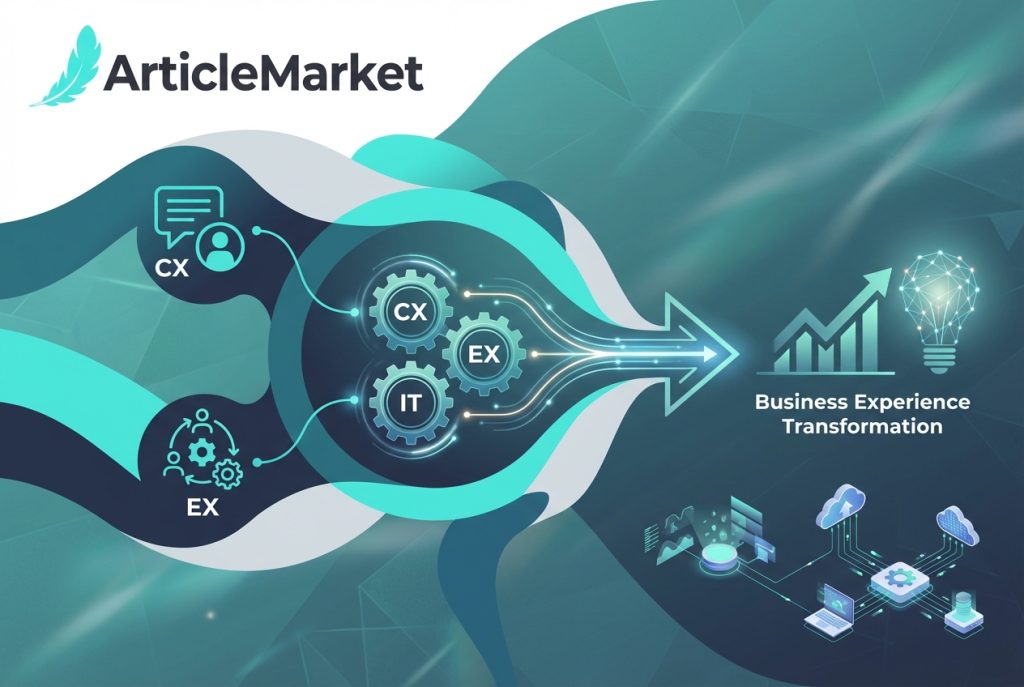
The problem was not effort. The problem was separation. In today’s digital-first world, customer experience (CX), employee experience (EX), and IT are no longer independent. They are deeply connected, and when one lags behind, the others suffer. True business experience transformation happens only when all three evolve together.
Understanding Business Experience
Business experience is the sum of every interaction a company creates. It includes how customers discover, buy, and receive support. It includes how employees collaborate, access tools, and feel about their work. It also includes how technology enables or limits both of those experiences.
When these elements are aligned, organizations feel smooth and responsive. When they are misaligned, friction shows up everywhere. Customers feel delays. Employees feel frustration. Leaders feel pressure but struggle to identify the root cause.
This is why business experience transformation has become a priority. It shifts the focus from fixing individual problems to improving how the entire organization functions as a connected system.
Why Customer Experience Alone Is Not Enough
Customer experience has been a major focus for many organizations over the last decade. Companies invested in better websites, faster response times, and personalized communication. While these efforts helped, many of them reached a plateau.
The reason is simple. Great customer experiences cannot exist without strong employee and IT foundations. A polished digital interface means very little if the support team behind it lacks the tools or authority to resolve issues quickly. Customers feel the gap immediately.
For example, a customer may submit a request through a modern portal, only to wait days for an update because the internal systems do not share information properly. From the customer’s perspective, the experience feels broken, even if each team did its job as designed.
CX improves only when employees can act confidently and technology supports their actions without friction.
Employee Experience Drives Customer Outcomes
Employees are the engine behind every customer interaction. If they struggle with outdated tools, unclear processes, or disconnected systems, their ability to serve customers suffers.
Employee experience is not just about benefits or culture statements. It is about how easy it is for people to do their jobs. Can they access the data they need without jumping between systems? Can they collaborate across teams without long email chains? Can they trust the information in front of them?
When employees feel supported by their tools, they spend more time solving problems and less time navigating obstacles. This confidence shows up in how they communicate with customers. Issues are resolved faster. Conversations feel more human. Trust grows naturally.
Organizations that invest in EX alongside CX often see improvements in customer satisfaction without changing their customer-facing strategy at all. The change happens behind the scenes, where it matters most.
IT as the Connector, Not the Gatekeeper
IT plays a critical role in business experience, yet it is often seen only as a support function. In reality, IT is the connective tissue that links customer and employee experiences together.
When IT systems are fragmented, data becomes inconsistent and slow. Teams rely on manual workarounds. Reporting lags behind reality. Decisions are made based on partial information. These issues create frustration for employees and confusion for customers.
When IT evolves into an integration-focused function, everything changes. Systems begin to talk to each other. Data flows across departments. Automation removes repetitive work. IT shifts from maintaining systems to enabling outcomes.
Modern IT is not about replacing everything at once. It is about connecting what already exists in a smarter way. Organizations that succeed focus on integration, adaptability, and visibility rather than constant reinvention.
The Cost of Siloed Evolution
Many organizations try to improve CX, EX, and IT independently. Each initiative may succeed on its own, but together they fail to create meaningful change.
A new customer platform might launch without considering how employees will use it. An internal tool might improve efficiency but fail to reflect real customer needs. An IT upgrade might focus on infrastructure without addressing user experience.
These disconnected efforts create more complexity, not less. Teams spend time managing the gaps between systems instead of delivering value. Leaders see investments increase while results remain flat.
Business experience transformation solves this by aligning goals across functions. Instead of asking how to improve CX, EX, or IT separately, organizations ask how to improve the experience of doing business as a whole.
Creating a Unified Experience Strategy
Successful transformation starts with a shared vision. Leaders from business, HR, and IT must align on what experience means for their organization. This includes defining clear outcomes for customers, employees, and operations.
From there, technology becomes an enabler rather than the starting point. Systems are evaluated based on how well they support people and processes together. Integration becomes a priority, allowing data to move freely and securely across the organization.
This approach also encourages better decision making. When leaders see real-time insights that reflect both customer and employee activity, they can respond faster and with greater confidence.
Companies like Epik Solutions work with organizations to design these unified strategies by focusing on integration-friendly platforms and measurable outcomes. The goal is not transformation for its own sake, but clarity that leads to growth.
Measuring What Matters
One of the most important aspects of business experience transformation is measurement. Traditional metrics often focus on isolated results, such as customer satisfaction scores or system uptime. While useful, these metrics do not tell the full story.
A more effective approach looks at how experiences interact. Are employee productivity improvements leading to faster customer resolution times? Are IT enhancements reducing both operational costs and employee frustration? Are customers staying longer because interactions feel easier and more consistent?
When CX, EX, and IT metrics are viewed together, patterns emerge. These insights allow organizations to adjust quickly and continuously improve, rather than waiting for problems to surface.
Culture as the Foundation
Technology and process changes will fail without the right culture. Business experience transformation requires collaboration across teams that may not have worked closely before. It requires openness to change and a willingness to rethink long-standing assumptions.
Organizations that succeed foster a culture where feedback flows freely, experimentation is encouraged, and learning is ongoing. Employees feel safe suggesting improvements because they see leadership taking experience seriously at every level.
This culture reinforces the transformation. As tools improve and processes simplify, people become more engaged. As engagement rises, customers feel the difference. Growth becomes a natural outcome rather than a forced target.
The Path Forward
The future belongs to organizations that understand experience as a system, not a set of isolated initiatives. Customers expect seamless interactions. Employees expect tools that respect their time. Leaders expect data that supports real decisions.
Meeting these expectations requires CX, EX, and IT to evolve together. When they do, businesses move faster, operate more efficiently, and build stronger relationships with everyone they serve.
Business experience transformation is not a one-time project. It is an ongoing commitment to alignment, clarity, and continuous improvement. Organizations that embrace this mindset position themselves not just to compete, but to lead in a world where experience defines success.
